

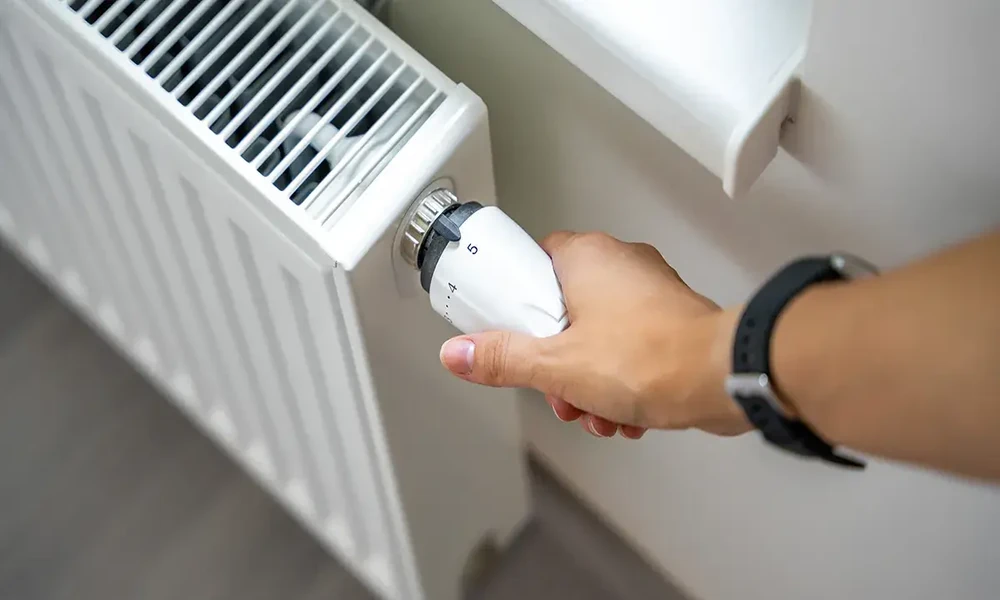
Three knocks. That’s the sound my neighbor’s radiator made in January before it quit entirely, and she spent the next eleven days waiting on a part she could have ordered a week earlier if she’d known what the noise meant. Most homeowners treat their heating system like a black box: heat comes out, or it doesn’t, and everything between the thermostat and the vent is somebody else’s mystery. That’s an expensive way to live through a Montana winter. You don’t need a wrench to read the signals, though. You need about twenty minutes and a willingness to look.
The trick is to think in clues before you think in repairs. Your system is telling you something with every gurgle, every cold spot, every spike on the gas bill. Learning to translate those signals saves you money in two directions: you catch small problems before they turn into emergency calls, and when you do need help, you describe the problem accurately instead of saying “it’s just not working.” When the time comes to hand it off, a crew offering heating system repair services in Butte, MT will spend less time diagnosing and more time fixing, which usually shows up on the invoice.
I’ve walked through this with a dozen neighbors over the years, and the same handful of clues come up again and again. Below is the order I’d check them in, plus the one thing most people get wrong about what their heater is actually doing.
Start with the cheapest answer first
Before anyone touches a pipe, check the thermostat batteries. Then check the breaker. Then check the filter if your system has one. I’m serious. A decent share of service calls end with a technician resetting a breaker or swapping two AA batteries, and you paid for the truck to drive out there. The Department of Energy has long noted that regular maintenance keeps heating equipment running at its rated efficiency, and the simplest maintenance is the stuff you can do from the hallway.
Here’s the sequence I use before I call anyone:
- Thermostat set to heat, not cool, and set at least three degrees above room temperature
- Batteries fresh if it’s a digital model, and the display isn’t showing a lock or a low-battery icon
- The breaker labeled for the furnace or boiler is fully on, not tripped halfway
- The air filter is clean enough to see light through
- The pilot or ignition light is doing whatever your manual says it should do
If all five check out and you’re still cold, now you have a real problem and you can describe it with confidence. That matters more than people realize.
What’s that noise actually telling you?
Heating systems are noisy in specific, diagnosable ways. A single loud bang at startup is usually a duct expanding, which is annoying but harmless. A sound like marbles rolling through the pipes is air in a hydronic loop. Rhythmic ticking that speeds up with the heat is metal expanding against a bracket. Whining from the boiler itself is different, and it tends to mean a circulator pump is straining.
My rule: if the noise is new to you and it repeats on every cycle, write it down in plain language. “Loud knocking from the basement for about ten seconds when the heat kicks on” gives a technician a running start. “It’s making a weird noise” gives them nothing, so they show up ready to diagnose from scratch.
Cold rooms tell a story about your layout
Uneven heat is the most common complaint I hear, and it’s usually about how the system was designed rather than a broken part. Hot water rises and follows the easiest path through pipes, so the radiator closest to the boiler gets the most heat while the far bedroom gets the leftovers. Zoning fixes this on some systems. On others, balancing valves or bleeding air from individual radiators does the job.
Try this experiment before you accept that your back room is just cold forever: close the valve on your hottest radiator halfway, wait a full day, and see whether the cold room catches up. That’s free, reversible, and it teaches you how your system distributes heat through the house. I’ve seen it solve a decade-old complaint in a single afternoon.
Why hydronic systems behave differently
Boilers heat water and move it through pipes, which means the failure modes look nothing like a forced-air furnace. Water doesn’t lose heat the way air does, so a boiler system can run cooler and still feel warmer, which is why so many older homes in the northern Rockies still use radiators and baseboards. They also fail differently: air pockets, low water pressure, sediment in the tank, and stuck zone valves. If your boiler pressure gauge is reading low and your upstairs radiators are cold while the basement is warm, you’re reading a textbook symptom, not a mystery.
Accessibility matters too. If you’re caring for someone with limited mobility, think about how heat reaches the rooms they spend time in, since a warm basement doesn’t help anyone living upstairs. The Department of Justice maintains guidance on accessible home design, and even small layout decisions around where warmth actually lands make a difference.
The one thing most homeowners misread
A rising gas or electric bill doesn’t automatically mean your heater is failing. It might be telling you that a door seal wore out, a filter is clogged, or a zone is running constantly because a thermostat is confused. Heating isn’t a single appliance; it’s a chain of parts, and the weakest link is usually outside the boiler itself.
I checked this myself last winter. My furnace ran fine, my bill jumped anyway, and the culprit was a quarter-inch gap under a basement door that had been there since I moved in. Twenty minutes with weatherstripping cut the bill back down. The National Institute of Standards and Technology does the measurement science behind building performance, and its work backs up a simple truth: stopping heat loss is often cheaper than producing more heat.
When to call it and when to keep watching
Call someone today if you smell gas, if there’s water pooling near the boiler, if you see soot or yellow flame where there should be blue, or if carbon monoxide alarms go off. That’s not a judgment call. Call, then leave the house.
Watch and note if it’s a gradual decline: rooms getting cooler over weeks, a boiler that short-cycles, a bill creeping upward. Those problems get easier and cheaper to fix when you have two weeks of observations written down than when you’re panicking in a cold snap.
The habit that pays you back
Keep a small notebook or a note on your phone labeled “heating.” Every time something seems off, log the date, the weather, what you heard or saw, and what you did. Within one season you’ll have a record no technician could guess at, and you’ll start noticing patterns before they become problems. That notebook is the single highest-value piece of heating equipment you’ll ever own, and it costs about two dollars.
Your heater has been talking to you all winter. Now you know enough of the language to hold up your end of the conversation. Go check your thermostat right now, honestly, just to see, and tell me what it says.
