

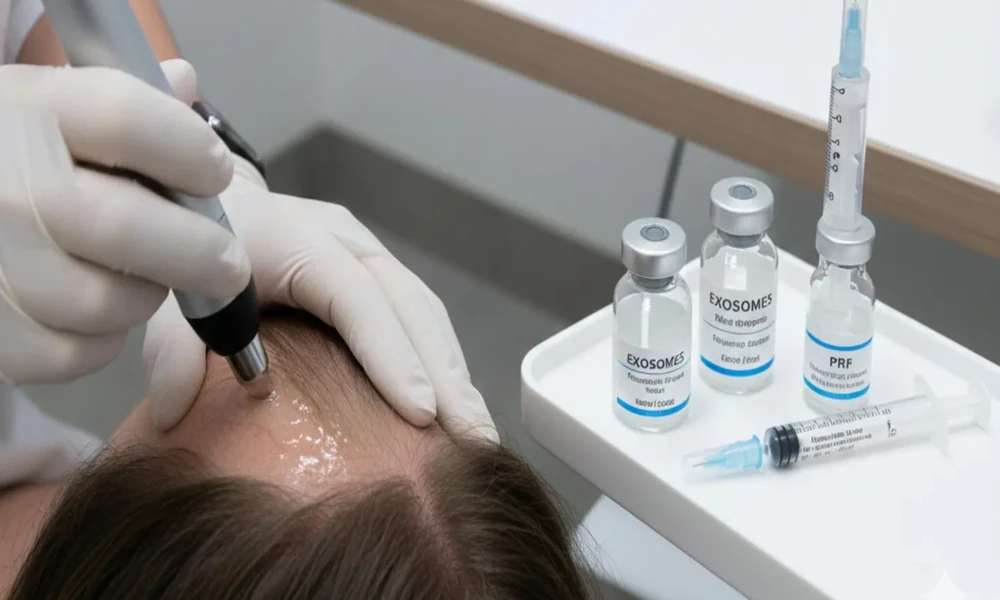
Hair loss isn’t just a cosmetic problem. For many, it strikes at confidence and self-image. What if science could offer a way to turn back the clock on thinning hair? Recent advances in regenerative aesthetics suggest that combining two powerful approaches, laser therapy and platelet-rich plasma (PRP), is setting a new standard for hair rejuvenation.
The Science Behind Hair Rejuvenation
Every strand of hair begins its journey within a follicle, a tiny but complex structure rooted in the scalp. Factors like genetics, hormones, aging, and stress can disrupt the normal growth cycle, causing follicles to shrink or become dormant. When follicles remain alive but inactive, there’s still a window of opportunity for rejuvenation.
Platelets, the cell fragments in our blood, release growth factors that trigger healing and tissue regeneration. These growth factors, IGF, VEGF, FGF, EGF, KGF, and CTGF, act like biochemical signals, waking up sluggish follicles and encouraging new hair growth.
Platelet-Rich Plasma (PRP) Therapy Explained
What exactly happens during PRP therapy? After drawing a small vial of your blood, the sample is spun in a centrifuge to isolate plasma that’s rich in platelets. This “liquid gold” is then injected into areas of thinning hair, delivering a concentrated dose of growth factors directly where they’re needed.
Once injected, PRP prompts follicles to move into an active growth phase, thickening existing hair and sometimes even reviving dormant strands. However, PRP isn’t magic. It can’t restore hair where follicles are entirely gone, but it can slow loss and improve density, especially when started early.
For anyone considering treatment, advantages include its natural, autologous nature (using your own blood), minimal downtime, and rare side effects. The main limitation? Results may be subtle or gradual, particularly in advanced hair loss.
Laser Therapy for Hair Restoration
Lasers are no longer just for skin care, they’re making a mark in hair medicine, too. Technologies like the Fotona Erbium Yag laser use controlled, gentle heat to stimulate tissue growth factors and boost blood flow to hair follicles. This “wake-up call” can encourage dormant follicles to re-enter the growth cycle.
Laser treatments are non-invasive, FDA-approved, and require little to no downtime. Patients often describe the process as comfortable and quick, typically lasting about 30 minutes per session.
Synergistic Effects of Combining PRP and Laser Therapy
Why settle for one therapy when two work better together? Research and clinical experience show that combining PRP and laser therapy amplifies results. The laser primes the scalp, increasing blood flow and making the tissue more receptive to PRP. This not only enhances absorption but also boosts the efficacy of the growth factors in PRP.
Patients who undergo combined treatments frequently report greater increases in hair density, thickness, and overall quality compared to single modalities.
Treatment Protocols and Practical Considerations
A typical regimen blends laser sessions with PRP injections, either during the same visit or within a two-week window. Maintenance often involves touch-ups every 3 to 4 months, tailored to individual response. Because both treatments are noninvasive, they suit men and women alike, especially those in early stages of thinning.
Ideal candidates are individuals with active but weakened follicles. If baldness is advanced and follicles are lost, neither treatment can regrow new hair.
Comparing Combined Therapy with Single-Modality Approaches
| Approach | Effectiveness | Frequency | Downtime |
|—————|———————————–|————–|————-|
| PRP Alone | Moderate (gradual improvement) | Every 3-4 mos| Minimal |
| Laser Alone | Moderate (stimulates follicles) | Varies | None |
| Combined PRP + Laser | High (synergistic, faster results) | Every 3-4 mos| Minimal |
Combining therapies generally yields better and longer-lasting outcomes, though cost and time commitment can be higher. For many, enhanced results are worth the investment.
Addressing Common Concerns and Myths
Worried about safety? Both PRP and laser treatments are considered low-risk. Since PRP uses the patient’s own blood, allergic reactions are nearly impossible. Side effects, if any, are minor, mild redness or swelling that fade quickly.
Expectations, however, must remain grounded. Not everyone will achieve dramatic regrowth. Factors such as age, genetics, hormonal health, and degree of hair loss will influence results.
Future Directions in Hair Rejuvenation
The field is moving toward more personalized and powerful approaches. Emerging therapies, like exosome treatments from stem cells, show promise. Soon, clinics may integrate genetic and hormonal profiling to customize regimens even further.
For anyone seeking a trusted resource, Clinique Anti Aging prp hair treatment represents one example of how leading clinics are harnessing these combined strategies to help their patients look and feel their best.
Hair rejuvenation is no longer a dream but a fast-evolving reality. With the right combination of innovative therapies, thicker and healthier hair may be within reach for many more people than ever before.
